
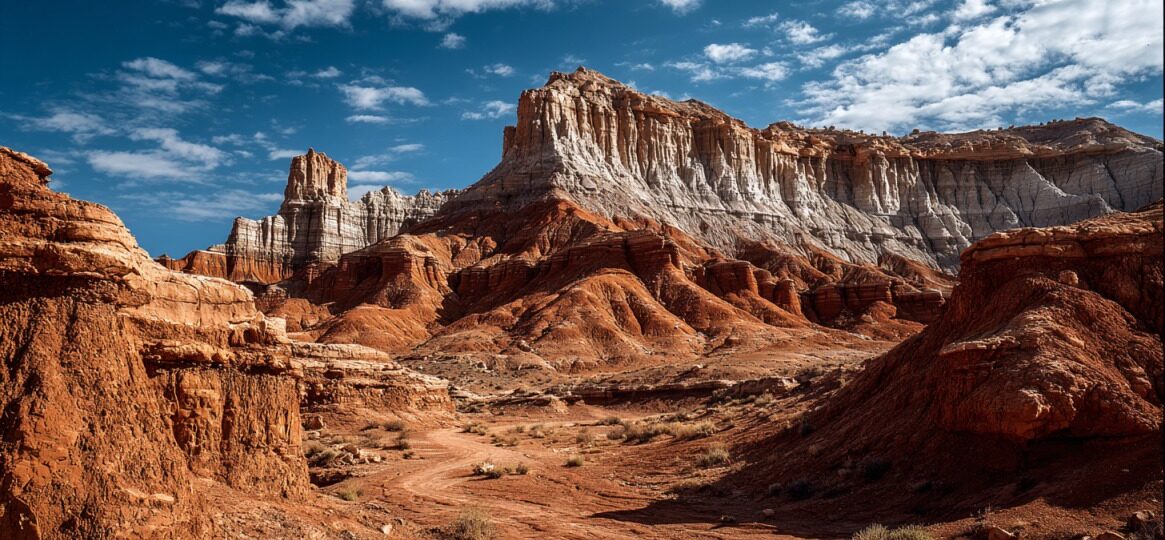

Southern Utah has deserts like the one near Hanksville, Utah feels like stepping into another world, shaped by strange clay hills, alien valleys, and wide gray plains that resemble scenes seen in space imagery.
Vast open views, muted colors, and sculpted ground create an atmosphere closer to science fiction than a typical road trip stop.
Five Mars-like areas sit outside national park boundaries, avoiding entry fees and heavy crowds while offering equally striking visuals. Adventurers, photographers, and travelers seeking surreal terrain often find these areas more immersive due to silence, scale, and minimal development.
Remote settings, raw geology, and sparse visitation combine to create a sense of discovery that feels rare in popular parts of the American Southwest.
Without further ado, let us talk about the spots in Southern Utah that will definitely make you feel like you are on Mars.
| Location | Core Visual Traits | Scientific or Notable Context | Crowd Levels |
|---|---|---|---|
| Bentonite Hills near Capitol Reef | Rolling clay mounds with red, purple, gray, and white striping; smooth eroded forms | Near the Mars Desert Research Station is used for Mars analog training | Very low |
| Moonscape Overlook in San Rafael Swell | Gray mesas, barren badlands, eroded ridges overlooking Blue Valley | Known for rapid light changes and planetary-style views | Low |
| Factory Butte and Surrounding Badlands | Dark sandstone butte rising out of pale clay flats; wide open horizons | Identified by Atlas Obscura as a top Mars-like setting | Low |
| Caineville Badlands | Jagged ridges, layered sediment, deep gullies, wind-carved ground | Terrain closely resembles Mars rover imagery | Very low |
| Mars Desert Research Station Area near Hanksville | Flat plains, clay soil, scattered rocks, minimal vegetation | Active Mars mission simulation and scientific training site | Low |
1. Bentonite Hills near Capitol Reef and the Mars Desert Research Station
Bentonite Hills stretch across rolling clay mounds shaped by water, minerals, and time, creating bands of red, purple, gray, and white that shift visibly as sunlight moves across the ground.
Smooth contours and muted tones mirror imagery often associated with Mars, giving the area a distinctly extraterrestrial character.
Proximity to the Mars Desert Research Station places these hills within a region actively used for Mars analog science and training. Astronaut-style simulations occur nearby, reinforcing how closely the terrain matches scientific expectations for Martian conditions.
Low-angle light produces the most striking visual contrast, especially during early morning and late evening hours.
- Clay layers that react dramatically to changing light
- Soft, rounded hills shaped by erosion rather than sharp rock
- Mineral staining that creates natural color striping
Travel requires navigating dirt roads east of Hanksville, with road conditions changing quickly after storms.
Moderate vehicle clearance improves access during dry weather. Crowds remain minimal compared to nearby national park viewpoints, allowing extended periods of quiet and uninterrupted views.
Ancient sediment deposits reveal long-term erosion processes, offering insight into how water and minerals shaped ground that now feels closer to another planet than a desert in Utah.
2. Moonscape Overlook in the San Rafael Swell and Blue Valley+
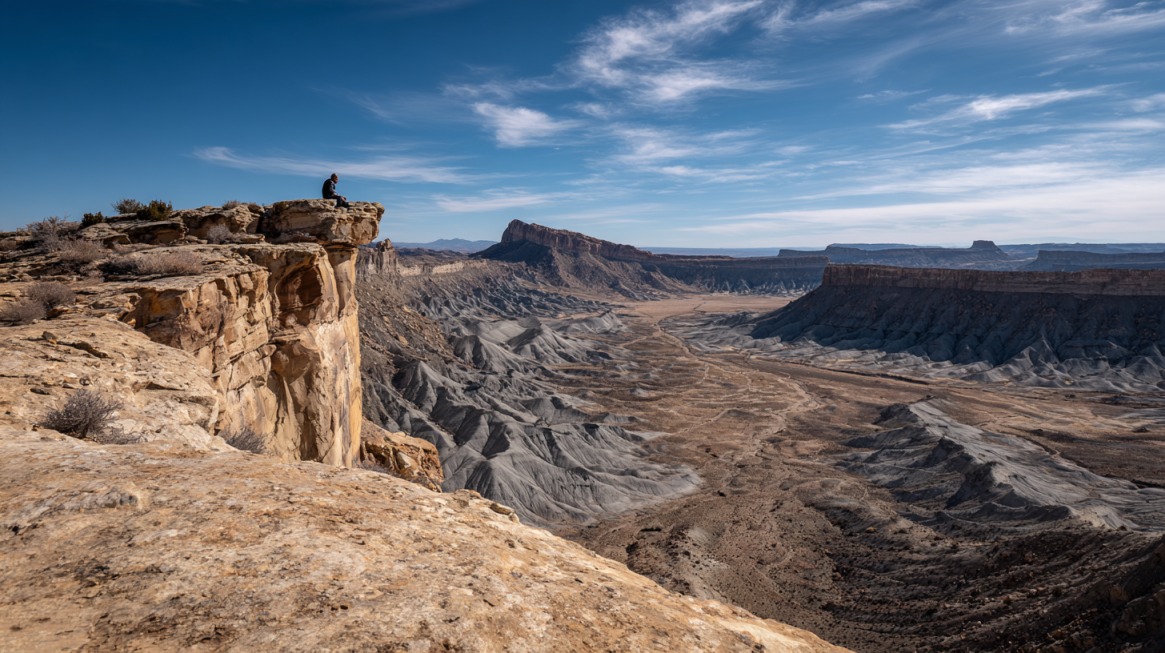
The next place in Southern Utah we want to talk about is Moonscape Overlook. Moonscape Overlook presents gray mesas and barren badlands that resemble lunar or Martian plains more than typical desert scenery.
Expansive views stretch across Blue Valley, exposing eroded ridges and winding gullies carved into layered earth.
Color shifts play a major role in shaping the experience, with light transforming the view within minutes.
Subtle blues, reds, and silvery grays emerge depending on cloud cover and sun angle. Visitor traffic remains low, creating space for quiet observation and photography without constant interruption.
- Rapid light changes across mesas and valleys
- Open viewpoints without fencing or heavy development
- Minimal ambient noise due to sparse visitation
Harsh textures, open sky, and wide visibility combine to create a feeling associated more with planetary observation than desert travel.
3. Factory Butte and Surrounding Badlands
View this post on Instagram
Factory Butte rises abruptly as a dark sandstone formation surrounded by pale clay flats and heavily eroded badlands. Visual impact feels immediate due to the stark contrast between the butte’s sheer faces and the light-toned ground stretching outward in every direction.
Atlas Obscura identifies the area as one of Utah’s most striking Mars-like settings, a description that aligns closely with firsthand impressions.
Heavy machinery, roads, and tourist infrastructure remain largely absent, allowing raw geology to dominate attention.
Ground conditions surrounding Factory Butte consist of wide open flats interrupted by low ridges, shallow washes, and erosion lines that appear etched into the surface. Recreational use centers on dispersed camping and off-road travel, attracting visitors who prioritize space, silence, and distance rather than comfort or amenities.
- Dark sandstone walls sharply contrasting with the light clay ground
- Vertical rock faces rising suddenly out of flat terrain
- Long, uninterrupted sightlines due to minimal vegetation
Minimal development paired with vast horizons creates a setting that feels more like an alien frontier than a familiar desert destination.
4. Caineville Badlands
Caineville Badlands extend across remote backcountry corridors east of Capitol Reef, shaped almost entirely by erosion. Jagged ridges, layered mounds, and wind-carved surfaces dominate the view, forming a fractured and highly textured environment.
Erosional forces define nearly every feature, carving deep gullies and exposing sediment layers that reveal long geological timelines. Movement through the area feels slow and deliberate due to uneven ground and visual complexity.
Color stays restrained yet varied, shifting between pale browns, muted reds, and soft grays depending on sunlight and cloud cover. Visitor numbers remain low compared to nearby roadside attractions, supporting quiet observation without pressure or interruption.
- Layered sediment revealed by long-term erosion
- Narrow ridgelines are divided by deep channels
- Sparse plant life caused by clay-heavy soil
Isolation and raw ground conditions closely resemble images transmitted by Mars rovers studying ancient terrain.
5. Mars Desert Research Station Area near Hanksville
@gnarlybygnature Sneaky space science peeks 👀🚀 #sciencetok #science #stem #learnscience ♬ original sound – Leah Elson
Finally, Mars Desert Research Station sits within a stark desert setting used for simulated Mars missions and scientific training.
Surrounding ground consists of flat plains, clay deposits, and scattered rock formations selected specifically for their similarity to Martian terrain.
Scientists and analog mission crews use the station to practice procedures designed for future space exploration. Public access remains possible outside the facility, allowing visitors to experience nearby terrain without interfering with research activity.
Visual austerity remains intact despite the station’s presence, as structures occupy only a small portion of the surrounding area. Nearby views already convey an extraterrestrial mood shaped by silence and scale.
- Broad plains with minimal elevation change
- Clay-rich soil supporting little vegetation
- Rocky surfaces suited for rover testing and movement
Sparse plant life, quiet surroundings, and expansive views reinforce how closely southern Utah can resemble another planet without leaving Earth.
Tips for Visiting Mars-Like in Southern Utah
Access often relies on dirt roads that change rapidly after rain, turning firm surfaces into impassable mud within hours. Preparation matters more than distance, as help can be far away and recovery options are limited.
High-clearance vehicles handle uneven ground better during dry conditions, while clay-heavy soil requires slow, deliberate driving to avoid damage and erosion.
Navigation presents its own challenges due to weak or nonexistent cell service across much of the region.
Digital preparation reduces risk, especially when signage is minimal or absent. Route planning should account for longer travel times and limited turnaround points.
- Offline maps downloaded in advance
- GPS units or navigation apps that function without a signal
- Paper maps as backup in case of device failure
View this post on Instagram
Safety concerns center on exposure rather than technical terrain. Open ground offers little shade, temperatures shift quickly, and distances between landmarks can be deceptive.
Packing decisions should reflect self-sufficiency rather than convenience.
- Carrying ample water due to lack of natural sources
- Sun protection and shade planning in open terrain
- Extra fuel when traveling long backcountry routes
Travel ethics play a role in preserving these areas. Clay soils and fragile surfaces erode easily under foot and tire traffic, leaving long-lasting scars.
Finding Your Own Red Planet
Southern Utah offers Mars-like experiences without national park crowds or heavy infrastructure. Vibrant clay hills, towering buttes, and stark plains provide scenes that feel far removed from everyday travel.
Quiet surroundings and open skies reward photographers and solitude-seekers alike. Martian terrain across the Hanksville region remains ready for discovery by those prepared to travel lightly and responsibly.