
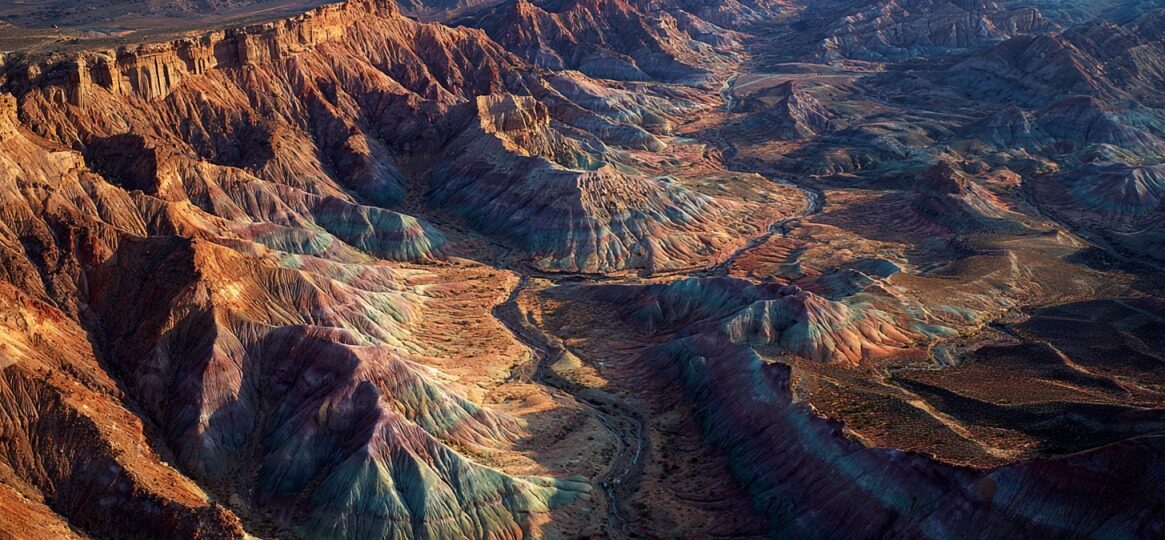

Photos of Bentonite Hills often circulate online with bold claims of Mars-like colors and unreal scenery. Social media posts and travel blogs frequently show intense reds, purples, and oranges that seem almost artificial, setting high expectations long before a visit ever happens.
Reality on site tells a more nuanced story shaped by geology, light, and weather rather than filters or extreme saturation.
That is why we want to talk about it today. We will try to separate visual hype tied to ideal lighting and photography choices versus what visitors actually see on the ground, helping expectations align more closely with experience.
Let’s go.
How Do the Bentonite Hills Look Like? (Geology and Visual Description)
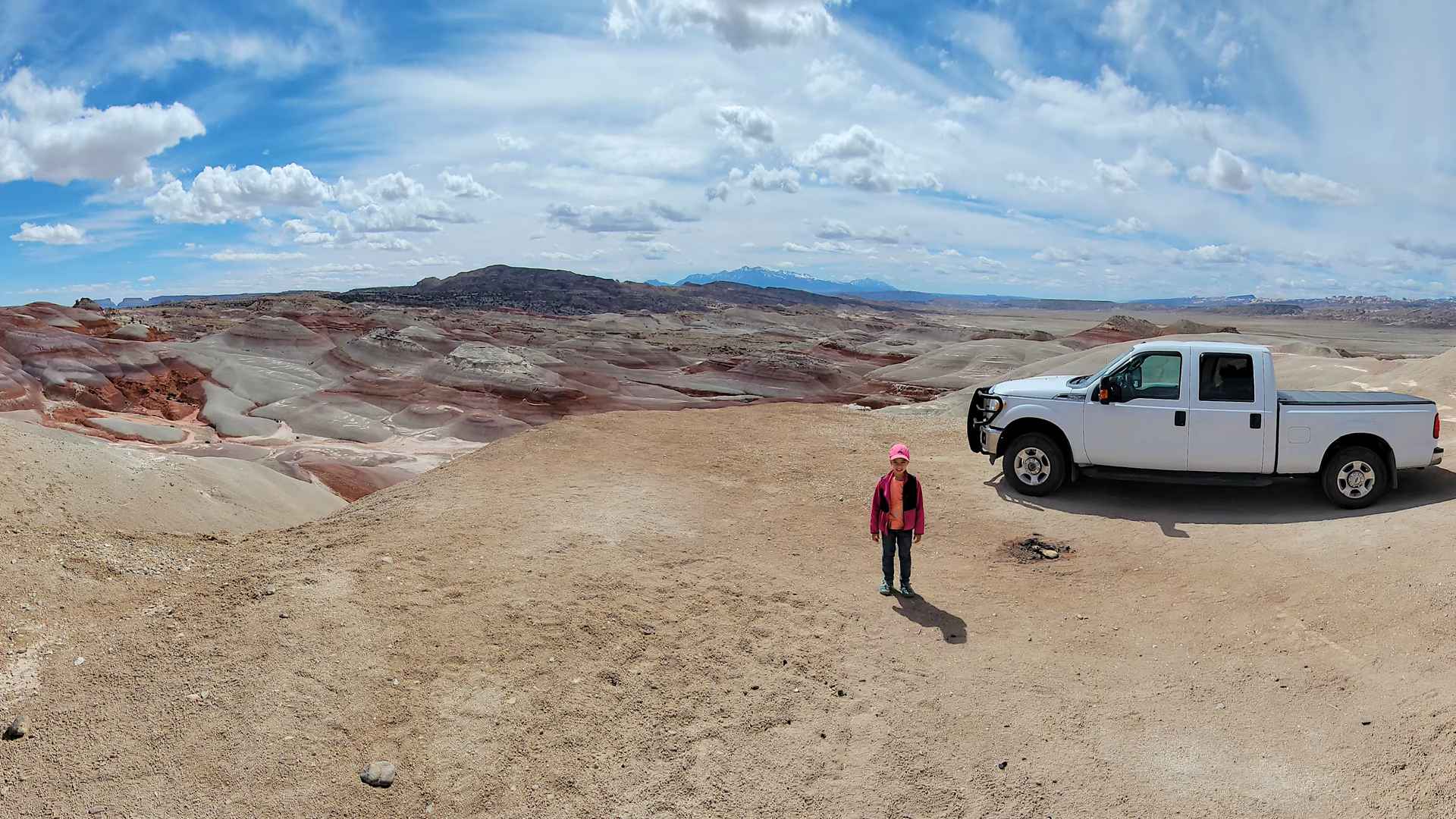
Bentonite Hills occupy a remote desert area near Hanksville, Utah, on Bureau of Land Management territory just east of Capitol Reef National Park. Public access comes without entrance fees, permits, signage, or developed facilities, giving the area a raw and undeveloped character.
Geographic isolation and minimal regulation allow visitors to see exposed geology without modern alterations.
Geological history reaches back about 140 million years to the Jurassic Period, when volcanic eruptions deposited layers of ash across ancient floodplains. Over time, ash altered into bentonite clay as it interacted with water, settling alongside mud, silt, and fine sand.
Deposits later became part of Brushy Basin Member of the Morrison Formation, now exposed by erosion.
- Bentonite Hills are formed by clay altered by volcanic ash
- Fine-grained mud and silt layers laid down by slow-moving water
- Sand lenses marking shifts in sediment flow and energy
Physical form appears soft and rounded due to clay composition and long-term weathering. Hills show horizontal banding created by subtle mineral changes and varying sediment layers.
@thewildlifeofrachWith its Mars-like terrain and surreal rainbow colors, it’s no wonder NASA has studied this area for planetary research. 👀 📍 Bentonite Hills, Utah 🗺️ Located near Capitol Reef National Park—about 30 minutes from Hanksville. Use these coordinates to find it: 38.4876° N, 111.2007° W 🌅 Pro tip: Go during golden hour or twilight. The soft light brings out the wildest purples, reds, and pinks in the hills. It’s unreal. 📸 Drones allowed! The best shots I got were from above, but you can still get some good ones with your camera. It’s remote. It’s bizarre. And it looks like another planet—no spaceship required. 🚀 ✨Follow @thewildlifeofrach for more hidden gems and bucket list destinations!♬ Ethereal – Txmy
- Browns and tans tied to clay-rich sediments
- Reds and oranges linked to iron oxides
- Purples, maroons, and grays associated with manganese and mixed minerals
- Occasional green and indigo hues appearing under angled light
Bentonite clay reacts strongly to moisture. Rainfall causes surfaces to swell, soften, and become slick, while dry conditions lead to shrinkage and cracking.
Repeating wet and dry cycles create a knobby, popcorn-like texture that covers slopes and ridges, giving hills a sculpted and almost artificial look up close.
Why People Think the Colors Look Like Mars
Mars comparisons come largely from visual resemblance rather than scientific equivalence. Layered hills, sparse vegetation, and exposed mineral bands echo imagery commonly associated with Martian surface photos shared by space agencies.
Popular travel photography reinforces that connection through dramatic framing and selective timing.
Regional context adds another layer to the narrative. Mars Desert Research Station operates nearby, using the surrounding terrain as a Mars analog for scientific research and astronaut training.
That association strengthens the idea that nearby hills share visual similarities with Mars-like conditions.
Light plays a critical role in shaping perception. Low-angle sunlight increases contrast and deepens shadows, which can dramatically change color visibility.
- Sunrise and sunset creating warm, directional light
- Thin cloud cover diffusing brightness while preserving contrast
- Low sun angles enhancing band separation and surface texture
Reality Check. Are the Mars Colors Real?
View this post on Instagram
On-site impressions often differ sharply from social media expectations. Online images frequently present intense reds, vivid purples, and saturated greens.
Human vision experiences a narrower range of color intensity, especially under direct desert sun.
Color appearance shifts depending on environmental factors encountered during a visit. Midday conditions often reduce contrast, causing hills to appear dominated by muted tans and light browns. Softer light later in day restores depth and separation between layers.
Mineral composition still plays a genuine role in color presence. Iron oxides account for reds and oranges, while manganese introduces darker purples and grays. Visual exaggeration usually enters through photography choices rather than geology.
- Camera sensors capturing broader dynamic range than human eyes
- Exposure adjustments that deepen shadows and boost saturation
- Post-processing that pushes color contrast for visual impact
Access and Visiting Experience
Remote character defines the entire visit, shaping expectations well before arrival. No visitor center, marked viewpoints, restrooms, or maintained paths exist in the area.
Responsibility for navigation, safety, and decision-making falls entirely on visitors, making preparation more important than at many popular desert destinations.
Getting There
Approach usually begins along UT-24 near Hanksville, with Cow Dung Road north of the highway acting as the primary access route. Smaller dirt tracks branch outward and lead closer to viewing areas, though no signage confirms exact destinations.
Road conditions change often due to weather, erosion, and vehicle traffic, so recent reports matter more than past experience.
Vehicle choice directly affects how far access extends. Dry conditions sometimes allow standard passenger vehicles to reach commonly visited areas, though clearance remains limited in spots. Storms can quickly transform firm dirt into slick clay, making even short distances difficult or impossible.
Access depends heavily on recent rainfall, the presence of ruts or washouts carved by runoff, and soft clay sections that trap low-clearance vehicles or tires without aggressive tread.
Terrain and Conditions
Movement on site involves walking across open ground without designated routes or established paths.
Hills consist of uneven slopes and fragile clay surfaces shaped by erosion. Wet bentonite clay becomes extremely slippery and sticky, adhering to shoes and tires and increasing the risk of falls or becoming stuck.
Dry conditions improve traction, though hardened surfaces crack into irregular patterns that demand careful footing.
Isolation adds another layer of responsibility during a visit. Cell service remains limited or nonexistent across much of the area, reducing access to real-time navigation or emergency communication. Preparation becomes essential and often determines how smoothly a visit goes.
Offline maps help with navigation, extra water and sun protection guard against desert exposure, and close attention to weather forecasts reduces the risk of encountering hazardous road or ground conditions unexpectedly.
Best Time to Visit
Timing plays a major role in both visual results and overall safety. Light angle affects how mineral bands appear, while temperature and ground conditions determine how accessible the area feels during a visit.
Planning around daylight and weather often makes the difference between muted tones and clearly defined color layers.
Early morning and late evening consistently deliver the most favorable viewing conditions. Lower sun angles reduce glare and increase shadow depth, allowing subtle transitions between layers to become more visible.
- Golden hour enhancing warm browns, reds, and oranges
- Blue hour softening contrast and bringing out purples, grays, and cooler tones
- Overcast conditions reducing harsh highlights while keeping colors subdued
Midday hours usually produce flatter visuals. High sun washes out contrast, leaving surfaces dominated by pale tans and light browns. Photography during this window often requires more effort to capture depth and texture.
Seasonal timing also affects comfort and access. Spring through autumn bring moderate daytime temperatures and longer daylight hours, making walking and photography more manageable.
Summer heat can become intense by late morning, encouraging earlier starts or evening visits.
Winter conditions change the experience entirely. Snow and ice may cover hills and roads, limiting access and altering color visibility. Dirt roads can become impassable for extended periods.
Rain poses the most immediate risk during any season.
Bentonite clay reacts quickly to moisture, turning roads and slopes into slick, sticky surfaces that trap tires and make walking hazardous.
Summary
Final take recognizes Bentonite Hills as visually striking formations shaped by natural earth processes, with color variation grounded in mineral composition and erosion.
Intense Mars-like colors seen online rely heavily on ideal lighting, camera settings, and editing choices.
Visiting with realistic expectations and focusing on geology, textures, and atmosphere usually leads to a more satisfying experience overall.